Most social monitoring tools are built around something static: a ticker symbol, a coin name, a stock. That works when your entire world is $BTC or $AAPL. It breaks down the moment your actual concern is something like "SEC enforcement action" or "DeFi rug" or your own brand name being discussed in ways that never touch your official handle.
Custom term collections exist to close that gap.
What a Custom Term Collection Is
A term collection is a defined set of keywords, hashtags, phrases, or account mentions that you want to monitor as a single aggregated feed. Instead of tracking one ticker at a time, you group related signals together and treat them as a single topic.

For example, a crypto exchange might create a collection around:
Their brand name (multiple spellings, common misspellings)
Their support hashtag
Key product terms like "limit order" or "futures fee"
Competitor comparisons people commonly post ("[Competitor] vs [Your Exchange]")
All of those roll up into one view: total social volume, sentiment trend, top posts, most active creators. You stop chasing fragments and start seeing the full conversation.
LunarCrush's API lets you build and query these collections programmatically, and the Enterprise tier supports advanced configurations for teams that need to run multiple collections at scale.
Why Standard Tickers Are Not Enough
Ticker-based tracking makes one critical assumption: that the conversation about your asset stays neatly inside a labeled box. It rarely does.
Consider a few real scenarios:
Scenario 1: Regulatory keyword monitoring. The phrase "SEC enforcement" spiked in early February 2026, generating over 30,000 engagements in a 48-hour window across X and Reddit. A crypto firm monitoring only their own ticker would have missed the early signal entirely. A term collection built around regulatory vocabulary would have flagged it the moment it started accelerating.
Scenario 2: Campaign measurement. A DeFi protocol runs a campaign with the hashtag #YieldSeason. There is no ticker for that hashtag. Traditional social tools have no way to aggregate that conversation. A custom term collection built around the campaign's core phrases captures every post, tracks which creators are driving reach, and measures sentiment as the campaign progresses.
Scenario 3: Competitor intelligence. You want to know what people say when they switch away from a competitor to your platform. The posts rarely mention tickers. They use phrases like "just moved from [Competitor]" or "[Competitor] fees are killing me." A term collection catches that language directly.
What Organizations Are Actually Tracking
The use cases vary widely by organization type. Here is what serious operators typically build:
Crypto projects and protocols track their project name plus common associated terms (chain name, major integrations, governance token). They also monitor competitor mentions to understand where market share conversations are happening.
Exchanges and trading platforms track support-related language to catch friction points before they escalate into public complaints. They also track feature names post-launch to measure adoption sentiment.
Asset managers and research firms build regulatory vocabulary collections around terms like "SEC," "CFTC," "enforcement," and specific bill names. When legislation gets discussed on social media before it hits mainstream financial news, the social signal precedes the price move.
Marketing teams track campaign hashtags and product announcement terms to measure organic reach against paid distribution. They also monitor brand safety terms to catch negative associations early.
Enterprise compliance teams track counterparty names, specific wallet addresses that have appeared in news, and terminology associated with known bad actors.
How to Think About Collection Design
A collection is only as useful as its signal-to-noise ratio. Building one requires the same thinking as good keyword research, but oriented toward conversational language rather than search intent.
A few principles:
Start with how people actually talk, not how you wish they would. Your brand might be "LunarCrush" but social posts often read "Lunar Crush" or "lunar crush" or "@lunarcrush." Include variations.
Layer your terms by intent. Separate brand terms from product terms from competitive terms. That structure lets you see which layer is driving volume on any given day.
Add adjacent context terms. A crypto exchange building a regulatory collection should include not just "SEC" but also "subpoena," "wells notice," "consent order," and the names of specific commissioners known for enforcement activity.
Review and prune quarterly. Conversations shift. A term that was signal six months ago might be noise today. Treat your collection like a living document.
Connecting Term Collections to Broader Intelligence
The real value of a well-designed term collection is what you do with the data once it's aggregated.
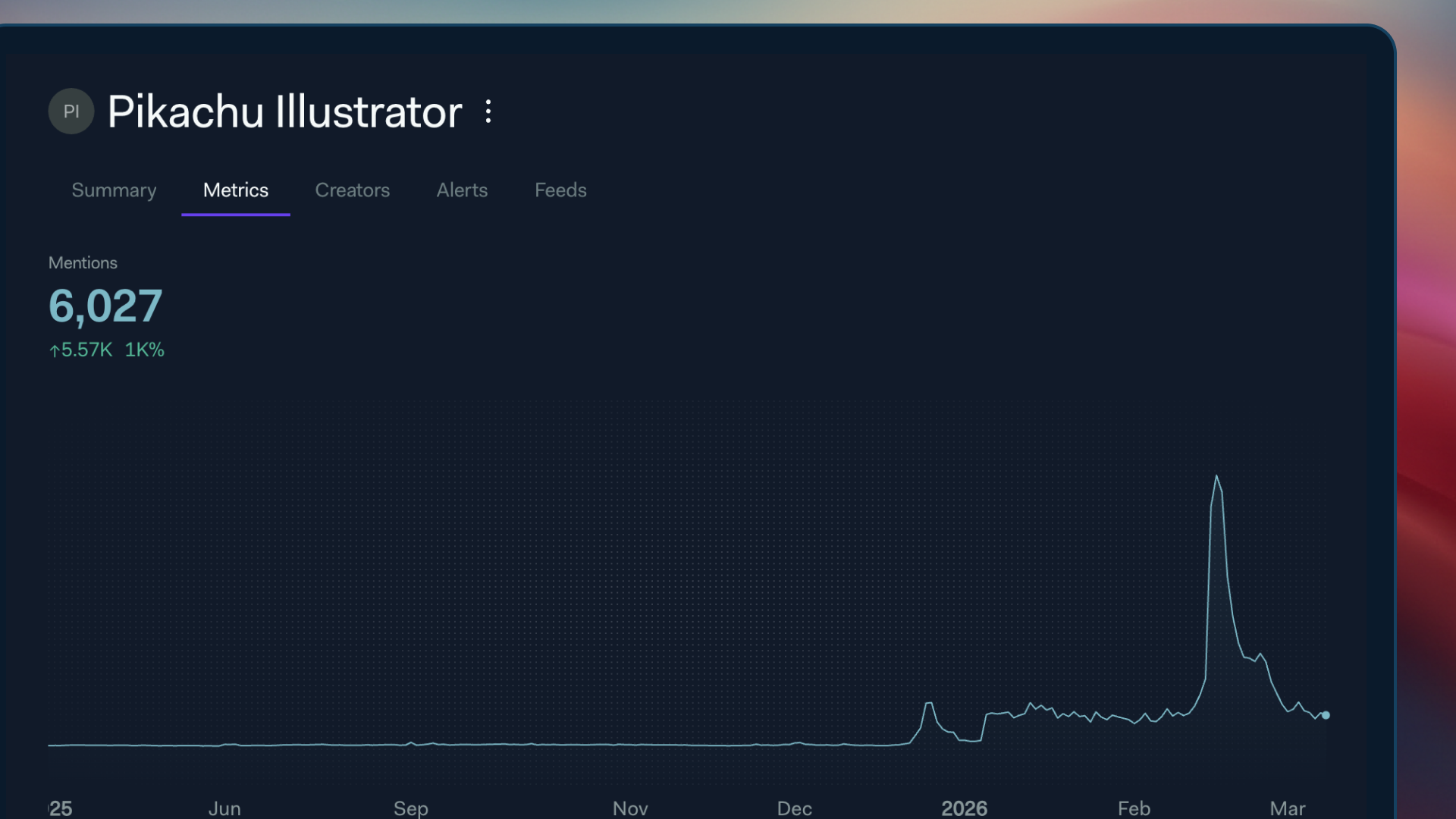
LunarCrush surfaces a set of metrics across any topic you define: total social interactions, active posts, active contributors, and sentiment score. When you build a custom term collection, those same metrics apply to your entire defined topic, not just a single asset.
That means you can:
Detect early-stage narrative shifts before they reach price action
Benchmark your own social footprint against an industry topic
Identify which platforms are driving your topic's conversation (is it X, or is Reddit gaining ground?)
Find the specific creators generating disproportionate reach within your topic and engage them directly
For teams building on top of this data, the LunarCrush API gives programmatic access to term-level metrics so you can feed them into your own dashboards, models, or alerting systems. For teams that want enterprise-grade access with dedicated support and higher query volumes, LunarCrush Enterprise is the right starting point.
The Bottom Line
Social conversations do not organize themselves around tickers. They organize around narratives, events, emotions, and language. Custom term collections let you monitor the actual conversation instead of the labeled version of it.
For any brand, research firm, or trading operation that needs to understand social dynamics beyond what a single ticker can show, term collections are not optional infrastructure. They are foundational.
The question is not whether to build them. It is how precisely to design them.